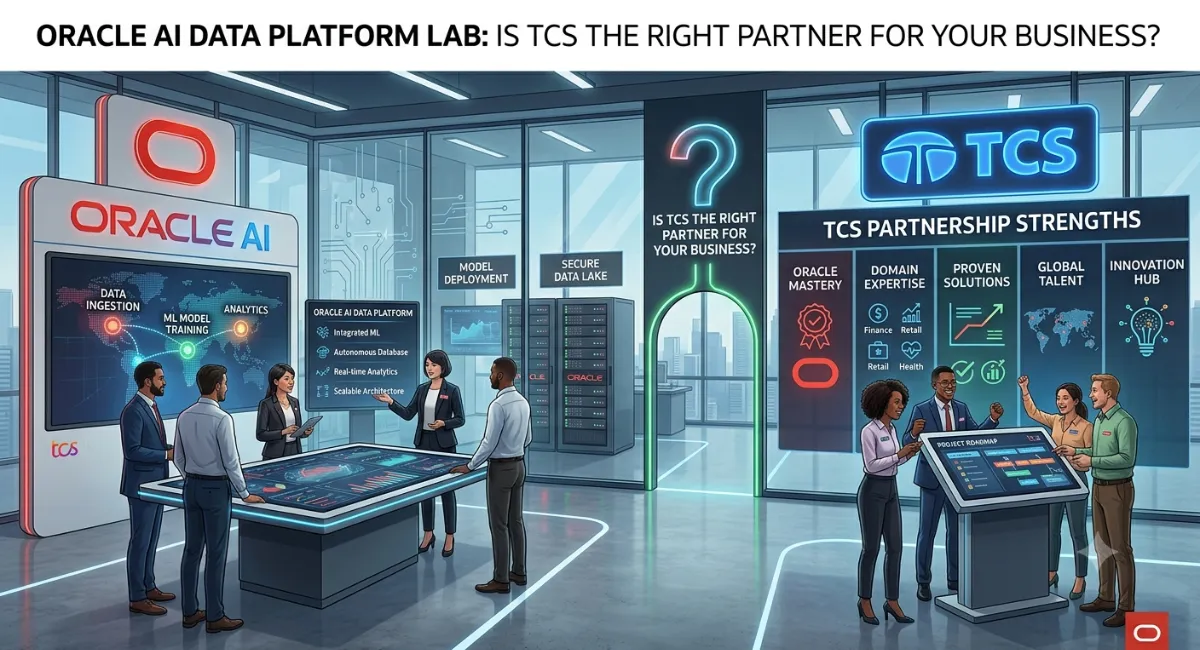
India got its first Oracle AI Data Platform Lab on June 12, 2026. TCS opened the facility at Delta Park Lords, Salt Lake Sector V, Kolkata, built on a 35-year partnership with Oracle. Before you decide whether this matters to your organization, here are the things worth paying attention to, ranked by how much they affect you.
- It solves a real problem most enterprises hit
The lab targets two pain points that kill AI projects: data scattered across too many systems, and pilots that work but never reach production. If your company has tried AI and stalled at the proof-of-concept stage, this is the specific problem TCS and Oracle designed the lab to fix. The framework they use moves teams from idea to experiment to full deployment, and the lab environment lets customers test at production scale before committing.
- The technology stack is mature, not experimental
The lab runs on Oracle Cloud Infrastructure, Oracle Autonomous AI Database, and OCI Enterprise AI. These are not new products. Oracle released the AI Data Platform in October 2025, and Indian system integrators collectively put $1.5 billion behind it. TCS’s share sits around $300 million. You’re not walking into a beta program. The infrastructure handles self-optimization, security patching, and availability without manual intervention, which matters if your IT team is already stretched.
- The talent pool is the real differentiator
TCS has 26,000 Oracle-skilled professionals in India. Infosys has roughly 20,000, Cognizant around 18,000, and LTIMindtree about 12,000. That gap is meaningful when you’re staffing a complex AI deployment that runs across multiple Oracle services. The lab in Kolkata draws from this pool directly, with AI architects and Oracle experts working jointly on customer projects.
- Industry solutions are pre-built, not custom-built from scratch
The lab offers reusable architectures, sector-specific accelerators, and pre-built data pipelines for industries including financial services, healthcare, manufacturing, retail, and government. If you’re in one of these verticals, you’re not starting from zero. That cuts both cost and timeline. For niche industries or unusual use cases, you may still need significant customization, so clarify this upfront.
- Four more labs are planned over the next three years
Kolkata is one of five labs TCS intends to build across India by 2029. The specific cities have not been announced. This matters if you’re evaluating whether to engage now or wait for a lab closer to your operations. The Kolkata lab already serves Oracle clients globally, so geography is less of a barrier than it sounds, but on-site collaboration is faster for complex projects.
- Security and compliance are built in, not bolted on
The Oracle Autonomous Database handles self-securing by default. The broader platform layers role-based access, end-to-end encryption, and audit trails on top of that. The lab aligns with India’s 2023 Data Protection Act, GDPR, HIPAA, PCI-DSS, and ISO 27001. If compliance is a blocker for your AI projects, this removes most of the common objections. Run your specific requirements past the team before signing, especially for regulated industries.
- The broader investment signals long-term commitment
TCS has proposed a $6.5 billion AI data centre and is forming a separate AI infrastructure subsidiary. This is not a lab opened for a press release. Capital-intensive commitments of this size take years to unwind, which means you can reasonably expect the Oracle practice to grow rather than shrink over the next five years.
What to watch for
The lab’s projected metrics, 40-60% faster deployments, 25-35% operational efficiency gains, come from TCS’s own projections, not independent audits. Treat them as targets, not guarantees. Ask for customer references in your industry before committing to a large engagement.
Quick Verdict: If your organization runs Oracle infrastructure and your AI initiatives keep stalling before production, this lab directly addresses your problem. The talent depth and pre-built industry solutions give TCS a real edge over competitors on Oracle-specific work. Engage now if you’re in Eastern India or already working with Oracle; otherwise, wait for the next lab location announcement before deciding.