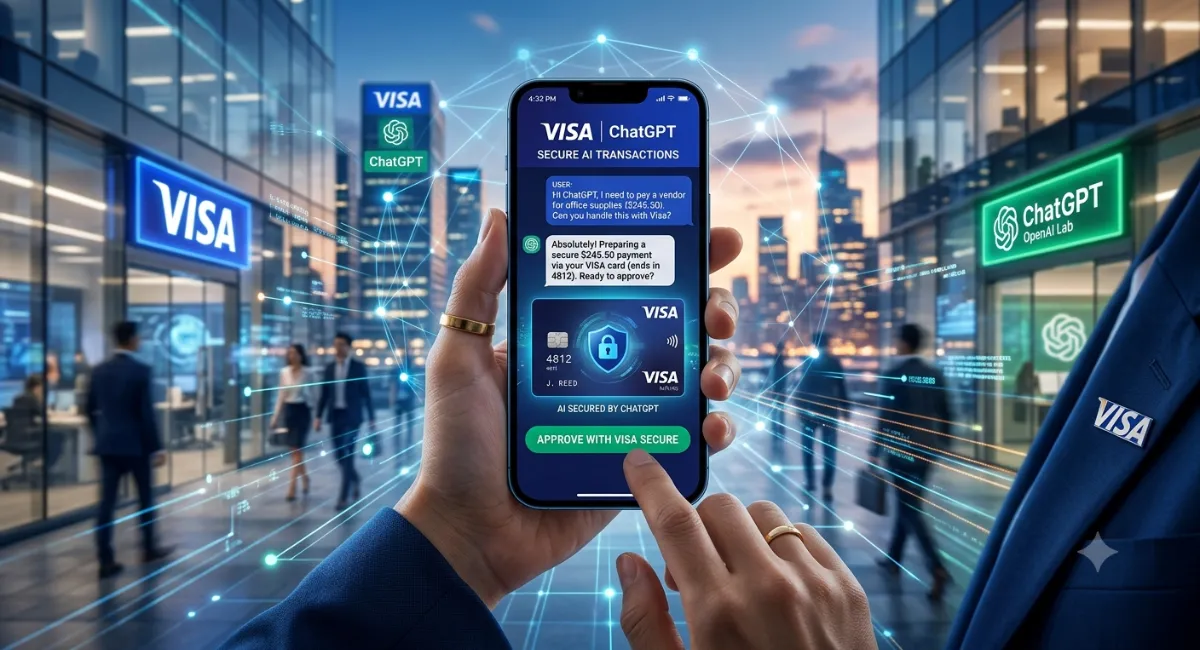
On June 10, 2026, Visa announced a payment partnership with OpenAI at the Visa Payments Forum in San Francisco. The short version: ChatGPT can now make purchases on your behalf, using your Visa card, at virtually any retailer that accepts Visa globally.
This isn’t a concept. Hundreds of transactions already went through during Visa’s pilot program, which started after their April 2025 product event. The partnership is live.
What it actually does
Before this, AI assistants could find you a good laptop. Now they can buy it. That’s the shift.
You tell ChatGPT what you want. “Order groceries for my weekly meals.” “Pay my electricity bill.” “Find wireless headphones under $150.” The AI searches retailers, compares prices and reviews, picks the best option, and completes the purchase through Visa’s payment network. The whole process takes roughly 3 to 5 seconds.
It works for one-off purchases, recurring orders, bill payments, subscription renewals, travel bookings, and eventually enterprise procurement. The practical use cases here cover most of what people spend money on.
The security setup
The most common question about something like this is obvious: who controls it?
You do. Before any transaction goes through, you configure spending limits (daily, weekly, per category), allowed merchant types, and whether purchases above a certain amount need your confirmation first. Small purchases can auto-approve. Larger ones ping you first.
Visa doesn’t store your actual card number in ChatGPT’s system. It uses tokenization, which replaces your card details with an encrypted stand-in. If that token gets exposed, it can’t be reversed into your real card number. Real-time fraud monitoring runs on every transaction. Everything is traceable, and transactions can be reversed if something goes wrong.
Seven layers of protection total, from identity verification at setup to post-transaction dispute handling. It’s more rigorous than what most people use for regular online checkout.
The important limits right now
AI agents cannot exceed the spending limits you set. They cannot purchase from merchant categories you’ve blocked. They cannot bypass confirmation on transactions you’ve flagged for review. They don’t have access to your raw card data, and they can’t move money between accounts.
One thing they can’t do yet: negotiate prices. The AI picks the best available price. It doesn’t haggle.
How to actually use it
Start with a low monthly limit, around $50 to $100, while you test how it handles your preferences. Use it first for routine, predictable purchases where a wrong choice is low stakes: household supplies, recurring subscriptions, bill payments. Check your transaction history weekly until you trust the pattern.
Once you’re comfortable, you can expand the scope. Price comparisons across five retailers happen in seconds. The AI factors in shipping time, review scores, and your previous purchase history. For anyone who spends meaningful time on routine shopping, the time savings are real.
The bigger picture
Visa is working with over 20 AI partners on this, including Anthropic, Microsoft, IBM, Mistral AI, Samsung, and Stripe. OpenAI is one node in a broader strategy, not the whole thing. Pilot programs in Asia and Europe are next.
For merchants, this creates pressure to optimize pricing and shipping speed because AI agents are doing the comparison work humans used to skip. Cart abandonment drops from roughly 70% to under 30% when an AI is doing the buying instead of a distracted person.
For investors, Visa projects AI-driven transactions could add 15 to 25% to their total volume by 2028.
Quick verdict
This is genuinely useful, not just impressive on paper. The security controls are solid. The time savings are real. Set tight limits, start small, and monitor your history. If Visa’s fraud infrastructure holds up at scale (and it has decades of practice), this becomes the obvious way to handle routine spending within a few years.