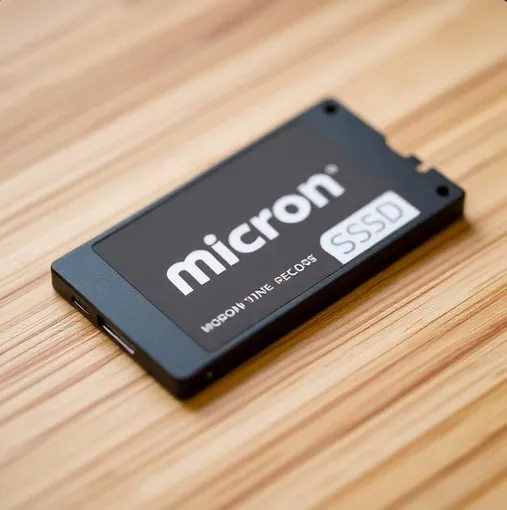
Data centers are drowning in data. AI workloads, cloud computing, and hyperscale applications are pushing storage infrastructure to its limits — and traditional hard drives simply cannot keep pace. Micron’s newly released 6600 ION addresses this crisis head-on, arriving as the highest-capacity commercial SSD ever shipped. Here’s a prioritized breakdown of everything that matters.
- The Capacity Milestone
At 245TB per drive (232TB usable), the 6600 ION rewrites what a single storage unit can hold. This is not a prototype or a lab experiment — volume shipments began in May 2026 through major OEMs including Dell, HPE, Lenovo, and Supermicro. A 122TB variant is also available for facilities that need flexibility. No other commercially shipping SSD comes close to this density, giving Micron a clear lead over competitors like Kioxia, whose comparable drive remains a non-shipping prototype.
- Power and Space Savings That Actually Matter
This is arguably where the drive earns its enterprise price tag. Running at roughly 22W during reads and 25W during writes, it consumes about 50–60% less power per terabyte than an equivalent hard drive array. At idle, it drops below 5W — a significant advantage for cold storage tiers that sit dormant for long periods.
The rack-space story is equally compelling. A single rack loaded with 6600 ION drives can hold up to 5 petabytes of storage, compared to roughly 900TB when using hard drives. That translates to 82% less rack space and 60% lower cooling requirements. For large facilities paying premium rates per square foot and per kilowatt-hour, those numbers mean serious budget relief over time — Micron projects 40–50% lower total cost of ownership over three years.
- Performance Numbers Worth Noting
Raw speed is strong across the board. Sequential reads reach 7,400 MB/s and writes hit 6,000 MB/s. For random workloads at queue depth 128, the drive delivers 1.6 million read IOPS and 1.2 million write IOPS. Under mixed conditions, performance stays consistent at 7,200/5,800 MB/s sequential and 1.4M/1.0M IOPS.
What separates this drive from consumer or prosumer alternatives is tail latency control. At the 99.9th percentile, read latency stays below 30 microseconds and write latency below 40 microseconds. For AI inference pipelines and real-time analytics, this consistency matters far more than peak throughput alone.
- The Technology Behind the Numbers
The 6600 ION is built on Micron’s 9th-generation QLC NAND, featuring 300+ layer stacking at an effective density exceeding 350 layers. It uses the E3.L form factor — a compact 7.8″ × 2.6″ × 0.37″ enterprise design sized for air-cooled racks. The PCIe 5.0 x4 NVMe interface with dual-port support ensures enterprise-grade reliability, and it remains backward compatible with PCIe Gen 3 and Gen 4 systems, simplifying upgrades in existing data centers.
Rather than relying on a DRAM cache, the drive uses Host Memory Buffer technology, which lowers component cost without sacrificing meaningful performance in enterprise deployments.
- Enterprise Security and Reliability
On the reliability side, the drive carries a 1 DWPD (drive writes per day) endurance rating over five years, with an MTBF exceeding 2.5 million hours. Power-loss protection capacitors guard against data corruption during outages, and LDPC error correction handles the wear patterns inherent to QLC NAND.
Security features align with strict enterprise requirements: AES-256 self-encrypting drive capability, TCG Opal 2.01, FIPS 140-3 Level 2/3 compliance, and Instant Sanitize for fast, certified data erasure. Up to 248 SR-IOV virtual functions support virtualized environments, and OpenTelemetry integration enables predictive maintenance before failures occur.
- Ideal Use Cases
The 6600 ION is purpose-built for AI training data lakes, vector databases used in retrieval-augmented generation (RAG) workflows, S3-compatible object storage, HPC file systems like Lustre and CephFS, and large-scale media archiving. Micron claims cold data access speeds roughly ten times faster than hard drives — a meaningful advantage for analytics pipelines that frequently revisit archived datasets.
Bottom line: If your infrastructure roadmap includes AI scalability, rack consolidation, or significant reductions in energy spend, the 6600 ION represents a genuine generational leap — not just an incremental upgrade.