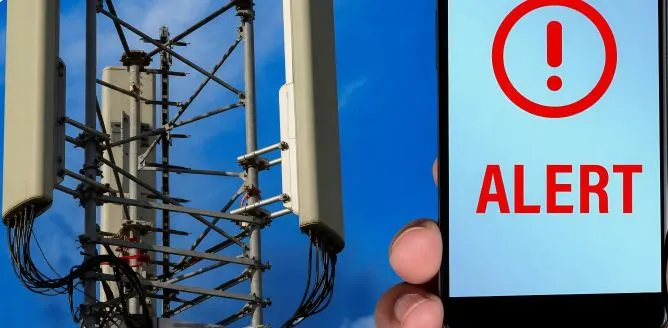
India just took a major step forward in public safety. On May 2, 2026, the government ran its biggest-ever test of a new emergency alert system — and if you own a modern smartphone, your phone was likely part of it. Here’s a breakdown of everything that matters, ranked by importance.
- What Actually Happened
Millions of phones across all 36 states and Union Territories received a loud, unavoidable test notification labeled “Extremely Severe Alert.” This was not a real emergency — it was a government-run drill coordinated by the National Disaster Management Authority (NDMA), the Department of Telecommunications (DoT), and telecom giants like Jio and Airtel. The rollout was staggered: Delhi-NCR received it first at 11:15 AM, state capitals followed at 11:45 AM, and the full nationwide push came at 12:15 PM.
- The Technology Behind It — Cell Broadcast vs. Regular SMS
This is the most important distinction to understand. Traditional SMS works by sending individual messages to specific phone numbers — a slow, congestion-prone method that fails exactly when you need it most (during disasters, when millions are texting at once).
Cell Broadcast works differently. It transmits one single message from a cell tower to every compatible device within a defined geographic area — simultaneously. No phone numbers needed. No queues. No congestion. The entire process, from alert trigger to your phone receiving it, takes under 60 seconds.
- No SIM Card? It Still Works
Here’s something surprising: your phone does not need an active SIM card to receive these alerts. Smartphones contain modems and antennas that independently scan cell tower signals — even when the phone shows “Emergency Calls Only.” Since Cell Broadcast uses unauthenticated radio channels, SIM authentication is bypassed entirely. This means even someone with an expired plan or no SIM inserted can still be warned.
- Your Phone Will Not Let You Ignore It
When an alert arrives, it is designed to be impossible to miss. The system emits a 70–90 decibel siren and forces the message onto your full screen — even if your phone is on silent or Do Not Disturb mode. The alert repeats every 15 minutes until you dismiss it. This is not a notification that quietly sits in your tray; it demands your attention.
- What Disasters Will It Cover?
The system is built for a wide range of threats, both natural and man-made. Natural disasters covered include earthquakes, tsunamis, cyclones, floods, lightning strikes, landslides, and forest fires. On the human-caused side, it handles gas leaks, chemical and radiological incidents, industrial accidents, and terror threats. AMBER-style child safety alerts are also within scope. Essentially, any time-critical public danger qualifies.
- Does Your Phone Support It?
Most modern smartphones do — but not all. The system requires a 4G or 5G device running Android 9 or later, or iOS 12 or later, with Cell Broadcast Message Identifier (CBMI) support enabled. Older 3G phones and basic feature phones cannot receive these alerts. You will also miss alerts if your phone is off, in airplane mode, deep inside a basement with no signal, or if you have manually disabled emergency alerts in your settings.
- How It Fits Into the Bigger SACHET System
Cell Broadcast is not a standalone tool — it is the newest and fastest layer added to India’s SACHET platform, which already sends SMS-based alerts and has delivered over 134 billion geo-targeted messages since 2025. SACHET now operates across multiple channels: Cell Broadcast, SMS (prefixed “XX-NDMAEW”), a mobile app, browser pop-ups, and TV/radio crawls. Together, these create redundant coverage so that if one channel fails during a crisis, others take over.
- What Comes Next
The May 2 test was not the final launch. A 2–4 week evaluation period will assess coverage gaps and device reach before the system goes fully operational around the clock. Rural areas with limited 4G infrastructure remain a challenge, and BSNL’s network expansion is expected to close those gaps over time.
India’s SACHET Cell Broadcast system places the country alongside global leaders like the US Wireless Emergency Alerts and Japan’s J-Alert — built entirely with indigenous technology and zero foreign vendor dependency.