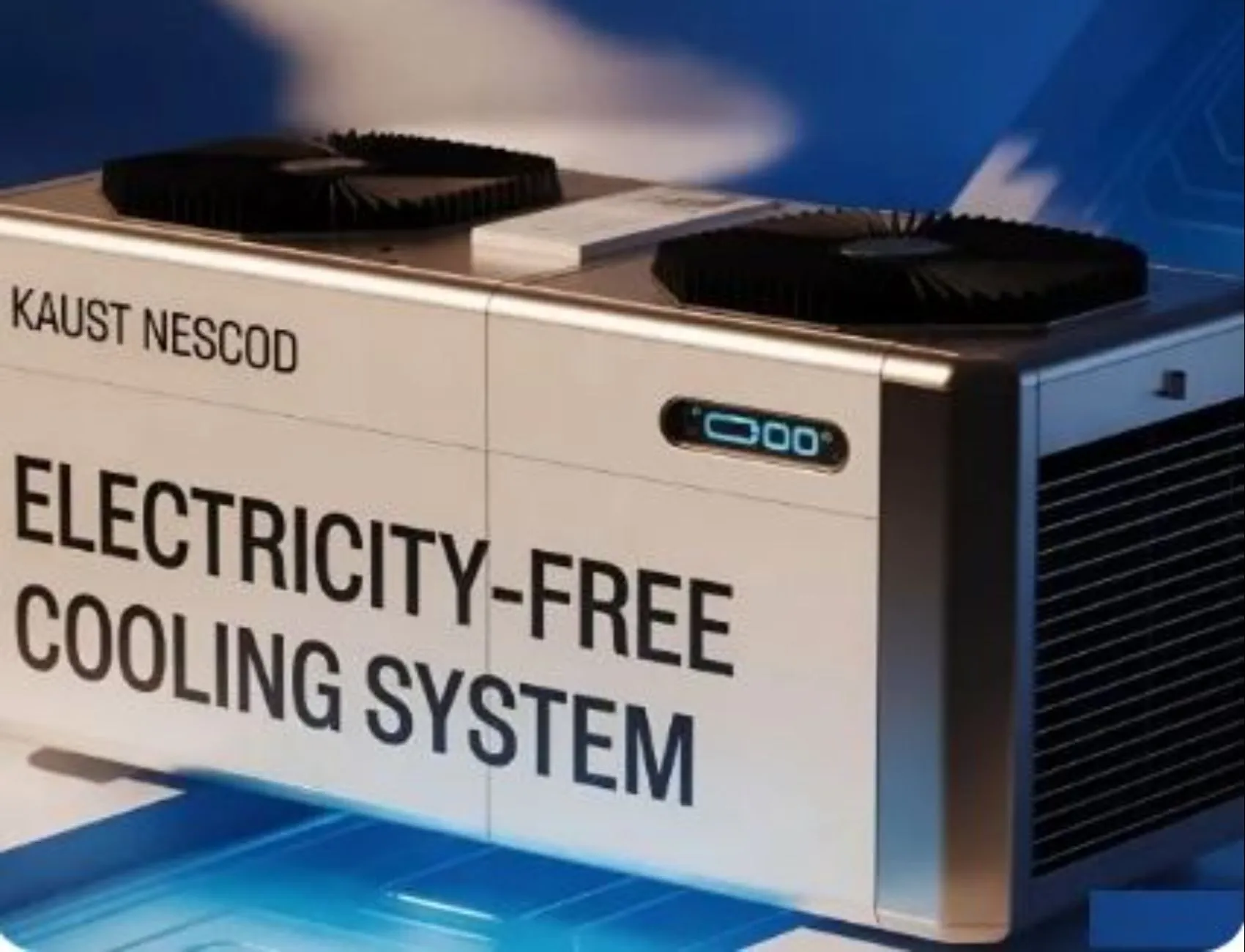
Heat is becoming a crisis. Summers across South Asia, the Middle East, and Africa regularly push past 50°C, and billions of people cannot afford air conditioning — or even access reliable electricity. For them, staying cool is not a comfort issue; it is a survival one. Nescod, developed by researchers at King Abdullah University of Science and Technology (KAUST) in Saudi Arabia, directly addresses that gap with a cooling system that requires zero electricity and costs less than a dollar to build.
The Most Important Thing to Understand First: How It Works
The core idea is surprisingly straightforward. When ammonium nitrate — a common, inexpensive fertilizer salt — dissolves in water, it pulls heat out of the surrounding environment. This chemical process, known as an endothermic reaction, can drop the temperature inside a sealed unit from 25°C down to about 3.6°C within 20 minutes. No compressor, no fan, no power outlet needed.
Once the cooling phase ends, sunlight does the recovery work. Solar heat evaporates the water back out of the solution, leaving behind dry salt crystals ready for the next cycle. As a bonus, the evaporation produces clean, drinkable water — so nothing is wasted. The system has been tested through over 200 full cycles with less than 1% loss in performance.
Performance Numbers That Matter
Before trusting any new technology, it helps to look at what it actually delivers:
- Cooling power: 191 W/m² under standard sunlight, with enhanced prototypes reaching 250 W/m²
- Runtime per charge: 15 to 18 hours
- Temperature drop: Maintains 10–15°C below outside temperature in a sealed 20m³ space
- Cost per unit: Under $1 at production scale, compared to $300+ for a conventional air conditioner
- Cycle life: 200+ uses without meaningful degradation
- Water recovery: Nearly 100% — each cycle even yields roughly 150–180ml of potable water as a byproduct
These are not lab-only figures. Field trials conducted in Saudi Arabia, the UAE, and Rajasthan, India between 2025 and 2026 confirmed 98–99.5% operational efficiency at ambient temperatures exceeding 50°C.
Where It Helps Most — Prioritized by Impact
- Healthcare and Vaccines (Highest Priority) Vaccines require storage between 2°C and 8°C. Cold chains in remote areas frequently fail due to power cuts, making preventable diseases resurface. Nescod holds temperature within WHO specs for 21+ hours without any power source, potentially serving 500 million off-grid vaccine doses annually.
- Food Storage and Agriculture Post-harvest food loss in countries like India runs as high as 30%. A low-cost, deployable cooling unit eliminates that waste without requiring refrigeration infrastructure. The system functions in 45°C ambient heat, making it viable precisely where food spoilage is worst.
- Disaster Relief and Refugee Situations Emergency cooling in refugee camps or disaster zones typically depends on diesel generators — expensive, loud, and polluting. Nescod units can be airlifted, activated with water, and recharged daily using sunlight alone.
- Low-Income Residential Cooling For families in hot climates spending a significant portion of their income on electricity bills — or going without cooling entirely — a sub-$1 unit that recharges daily represents a genuine quality-of-life shift. KAUST models suggest it could reduce peak electricity demand from air conditioning across the MENA region by 50–70%.
What to Keep in Mind
Nescod performs best in dry, arid climates. High humidity does not break the system — it tolerates up to 95% relative humidity with appropriate membranes — but its cooling advantage is most pronounced in hot, dry conditions. It also requires a daily window of direct sunlight for regeneration, which means cloudy regions need supplemental planning.
Commercialization is in progress. Manufacturing in Riyadh is targeting 50,000 units per month, with a global rollout of 100 million units aimed at 2030.
Bottom Line
Nescod is not a concept — it is a tested, scalable cooling solution built for the people who need it most. If you work in global health, humanitarian logistics, agriculture, or climate adaptation, this technology belongs on your radar now.