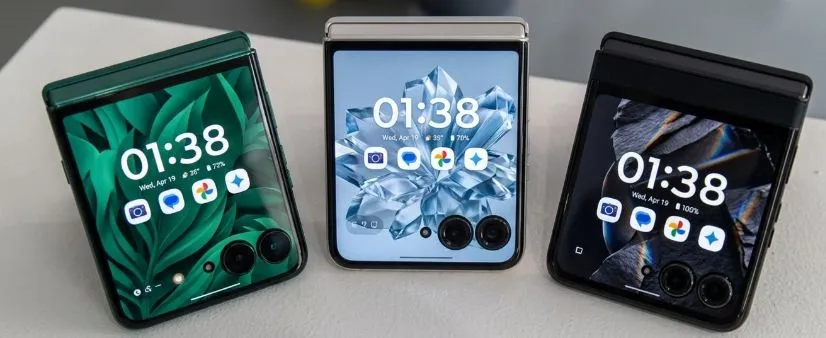
Think if you are at a café, your phone rings, and instead of swiping a glass slab, you snap it open with one hand like you’re in a spy movie. That’s the fantasy Motorola has been selling with the Razr for years. But with the Razr 2026 family dropping on April 29, it feels like they might actually be delivering on the promise this time.
So let me walk you through what’s coming and whether it’s worth getting excited about.
The Lineup: Three Phones, One Big Bet
Motorola isn’t just launching one phone — they’re bringing out an entire family. Think of it like 3 siblings: the base Razr 70 for everyday users, a mid-tier Razr+ for those who want a little more, and the Razr 70 Ultra for people who refuse to compromise. Each one gets progressively better hardware, and the idea is simple — find your budget, find your phone.
Design: Finally Feeling Premium
Here’s where things get interesting. Motorola seems to have heard the feedback about earlier Razr models feeling a bit plasticky. The 2026 lineup uses fabric-like, quilt-textured backs in shades like walnut, forest green, and violet. It sounds unusual, but think of it like wearing a well-tailored jacket versus an off-the-rack blazer — you just feel the difference when you hold it.
The hinge has also been upgraded with titanium reinforcement. If you’ve ever worried about a foldable cracking or creasing after a year of use, this is Motorola directly addressing that fear.
Screens: Two Displays, Actually Useful
The inner screen on the Ultra stretches to about 7.1 inches with a 165Hz refresh rate. That’s smoother than most flagship phones out there. But the real story is the outer cover screen — now around 4 inches and capable of full widgets, camera use, and quick replies without ever unfolding the phone. It’s not a gimmick anymore; it’s genuinely functional.
The Guts: Mid-Range vs. Monster
If you go with the base Razr 70, you’re getting a solid MediaTek chip — perfectly fine for Instagram, WhatsApp, Netflix, and the occasional game. But if you choose the Ultra, Motorola has stuffed in a Snapdragon 8 Elite, 16GB of RAM, and 512GB storage. That’s the kind of hardware that laughs at heavy workloads and 4K video recording. These are two very different phones under the same design language, which is both smart and a little confusing — so know which one you’re buying.
Battery and Cameras: The Ultra Earns Its Name
The base model gets a 4,500mAh battery with 33W charging. Decent, but nothing to write home about. The Ultra, though, bumps up to around 5,000mAh with up to 80W wired charging and 45W wireless. For a foldable — which traditionally struggle with battery life — this is genuinely impressive.
On cameras, both models use a 50MP main shooter. The Ultra pairs it with a 50MP ultra-wide and adds a 50MP selfie camera on the inside. Motorola is pushing hard on AI photography tools here — think automatic scene adjustments, AI editing, portrait enhancement, all under their “moto ai” umbrella. Whether the real-world photos live up to the spec sheet is something we’ll know after April 29.
Software and AI: More Than a Buzzword
The phones launch with Android 16, and Motorola has layered their moto ai features on top — smart suggestions, note-taking, media editing, voice automation. They’re also tying this into Lenovo’s broader ecosystem, meaning your Razr can talk to your ThinkPad laptop or Lenovo tablet more seamlessly than before. It’s a genuine ecosystem play, not just feature-checklist padding.
Price Check: Who Is This For?
The base Razr 70 should land between $899–$1,099 globally, with the Ultra pushing $1,299–$1,399. For India, expect the Ultra somewhere in the Rs.1,10,000–Rs.1,40,000 range, likely arriving mid-2026.
This is squarely aimed at content creators, vloggers, and people who want a phone that turns heads. If you’re a benchmark-chaser or a heavy gamer, there are better options. But if compact style plus serious camera and AI capability is your thing, the Razr 2026 family might just be the most compelling flip phone yet.