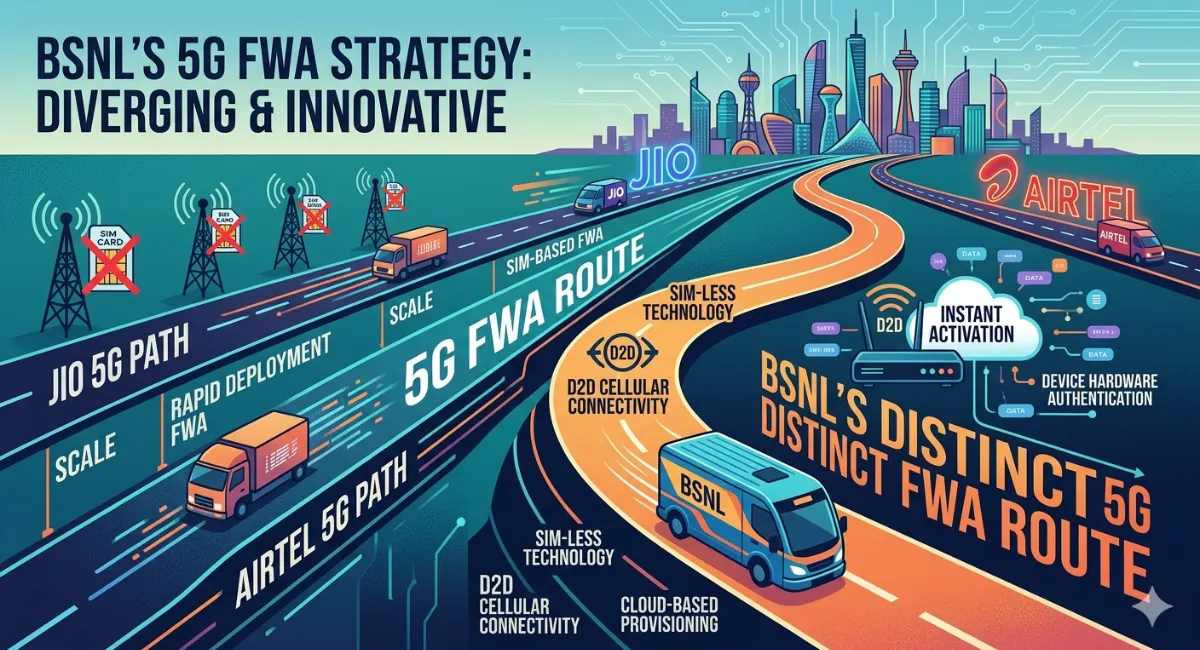
India’s broadband market just got more interesting. BSNL’s Quantum 5G FWA, launched in Hyderabad in June 2025, does something neither Jio nor Airtel does: it drops the SIM card completely. No physical card. No insertion. The gateway authenticates itself via an embedded hardware ID the moment you plug it in. That’s not a minor tweak, it’s a different philosophy about how home internet should work.
The SIM-less factor matters more than you think
BSNL built its authentication around a cloud-based system called the Direct-to-Device (D2D) platform. Your CPE gateway has a chipset-level identifier baked in at the factory. When you power it on, that ID goes to BSNL’s cloud database, gets verified, and the session opens automatically. No SIM to insert, lose, or get defrauded through. For individual users, that means setup in five minutes. For enterprises deploying hundreds of devices, the operational savings are significant.
Jio and Airtel still require a physical 5G SIM in the gateway. That model works fine, but it adds manufacturing costs, distribution logistics, and one more thing that can go wrong.
The indigenous stack is real
Every layer of BSNL’s 5G network came from Indian vendors. TCS and C-DoT built the 5G standalone core. Tejas Networks and Lekha Wireless supply the radio hardware. Tejas, ITI, and VVDN make the CPE gateways. This isn’t a point of national pride dressed up as a technical claim. It matters because the entire system uses a 5G Standalone architecture, unlike Airtel, which launched on a Non-Standalone core and is still migrating. Standalone means proper network slicing, lower latency, and SLA-backed enterprise links are all possible now rather than later.
Performance and pricing ranked honestly
The tested speed at the Hyderabad pilot site was 980 Mbps download and 140 Mbps upload, with sub-10 ms latency. Those numbers are real, pulled from a single test site under controlled conditions. Your home will likely land somewhere between 300 and 700 Mbps depending on tower distance.
On pricing, the Entry plan at Rs.999 gives you 100 Mbps. The Premium at Rs.1,499 gives you 300 Mbps. Compare that to Jio, which also offers 300 Mbps at Rs.1,499. The difference is that BSNL’s plan is data only. No voice calls, no OTT subscriptions, no live TV. Jio bundles 14+ streaming apps and 800+ TV channels. If you already pay for Netflix and Spotify separately and just want a fast pipe, BSNL wins on value. If entertainment bundles matter to you, Jio’s package is harder to beat.
Rural coverage is BSNL’s real weapon
Jio and Airtel focus on urban density. BSNL holds 700 MHz spectrum, which travels farther and penetrates walls better than the mid-band frequencies private operators lean on. In Hyderabad, 85% of households sit under existing BSNL towers with no new construction. In rural and semi-urban areas where fiber is years away and private 5G barely reaches, BSNL’s tower grid plus 700 MHz makes this the only realistic gigabit option.
Where it falls short right now
The soft launch is Hyderabad only. Six more cities including Bengaluru and Pune were targeted by September 2025, with metro expansion and nationwide rollout coming through 2026-27. If you’re outside Hyderabad, this is something to track, not buy yet.
The data-only limitation is real. You need a separate phone plan for calls. The FUP limit isn’t officially specified, though industry standard suggests around 1 TB before speeds drop.
Quick verdict
BSNL Q-5G is the right product for three types of users: people who want a fast, no-frills broadband connection without paying for streaming bundles they don’t watch; businesses that need SLA-backed connectivity without SIM management overhead; and anyone in underserved areas where private operators simply don’t show up.
It won’t replace Jio for entertainment-heavy households. But as a pure internet connection, Rs.999 for 100 Mbps with plug-and-play setup and zero SIM hassle is a solid deal.