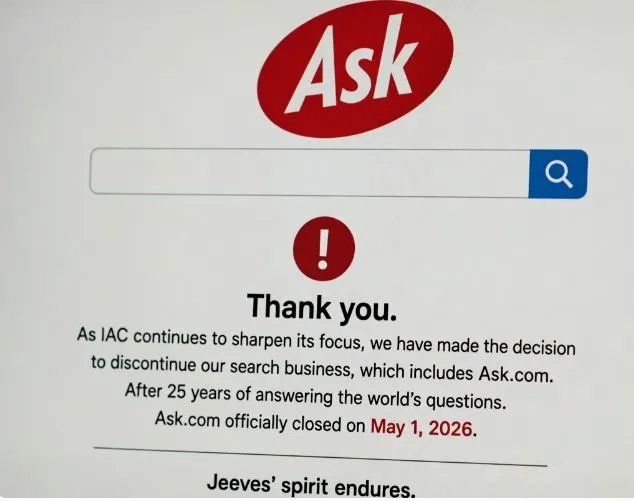
The internet quietly lost one of its oldest landmarks on May 1, 2026. Ask.com, the platform that once promised to answer any question you could type, switched off its servers for good. For anyone who used it during the early days of the web, this feels like the end of an era. For everyone else, it raises a bigger question: what does this shutdown actually tell us about where search is headed?
Why This Shutdown Matters Most
The most important takeaway is not that Ask.com failed — it is why it failed, and what replaced it. Parent company IAC did not quietly let the site fade away. It made a deliberate business decision to shut down its entire search operation and redirect resources toward higher-margin businesses like Angi, Vimeo, and Dotdash Meredith. Traditional search, in IAC’s view, no longer earns its keep.
This matters because Ask.com held less than 1% of the search market by 2025. That tiny number tells a stark story: users had already moved on long before the official closure. The homepage now reads, “After 25 years of answering the world’s questions, Ask.com officially closed on May 1, 2026.” It is a graceful farewell for a platform that never quite found its footing after the mid-2000s.
The Rise, the Peak, and the Long Decline
Understanding the timeline helps put the shutdown in perspective. Ask Jeeves launched in 1996, founded by Garrett Gruener and David Warthen, and went public in 1997 with a butler mascot that became instantly recognizable. The big idea was natural language search — typing questions the way you would ask a real person, rather than stringing keywords together. That was genuinely ahead of its time.
IAC acquired the platform in 2005 for $1.85 billion, dropped the Jeeves branding, and pushed hard to compete with Google. That effort failed. By 2010, IAC’s own Barry Diller publicly admitted Google was unbeatable. The company shifted Ask.com toward Q&A communities, a pivot that briefly worked — the platform hit 100 million monthly users in 2012. But the smartphone era exposed its weaknesses. Mobile adaptation was poor, the interface felt cluttered, and Google’s speed and scale proved impossible to match. Traffic collapsed through the 2020s, and the AI wave that began reshaping search after 2022 finished off whatever relevance Ask.com had left.
The AI Factor: Ask Jeeves Was Right All Along
Here is the irony worth paying attention to. The conversational search model that Ask Jeeves pioneered in 1997 — the idea that users should get direct answers rather than a list of links to chase — is now the dominant design philosophy of modern AI tools. ChatGPT, Perplexity, and Google’s AI Overviews all deliver synthesized responses without requiring users to click through multiple websites. Ask Jeeves imagined this future; it simply lacked the technology to build it.
The platform’s Teoma algorithm, acquired in 2001, was also an early attempt at relevance ranking that influenced how search engines would eventually evaluate web content. These were real innovations. The failure was not vision — it was execution and timing.
What This Means for Users and the Broader Web
For current users, the practical impact is minimal. Ask.com’s market share had shrunk to almost nothing, so daily browsing habits will not change. However, the site hosted a significant archive of Q&A content built up over decades, and no data migration or export plan has been announced. That historical record appears to be gone.
The broader implication is more significant. Ask.com’s closure signals the end of the pre-Google generation of search engines, a group that includes AltaVista, Lycos, and Excite. The search landscape is now consolidating rapidly around AI-powered tools, and smaller link-based engines face an existential question about whether they can survive in that environment.
Final Assessment
Ask.com’s shutdown is not a surprise, but it is worth pausing on. It closes the chapter on dot-com era search optimism and confirms that the industry has fully pivoted toward generative AI. The platform deserves credit for pioneering ideas that are now standard. Its inability to scale those ideas, however, is a cautionary lesson about how early innovation without sustained execution rarely survives the long game.