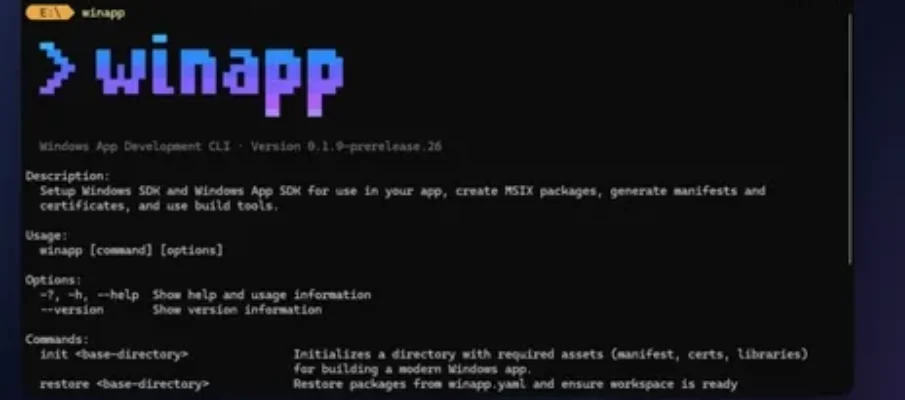
Microsoft launched WinApp CLI on January 22, 2026, as an open-source tool to simplify how developers build Windows applications. It acts as a single command-line interface that consolidates complex tasks like setting up environments, managing SDKs, and creating app identities. By moving these processes into a CLI, Microsoft is making Windows development more accessible to those who prefer working outside of traditional environments like Visual Studio or MSBuild.
Technical Capabilities and Workflow
The tool is built using Node.js and Rust for speed and features a modular system where commands like winapp init or winapp package handle specific tasks. It automates dependency management by detecting installed SDKs and removes the need for manual XML editing by providing a manifest abstraction layer. Developers can initialize a project, develop using their preferred framework, and then package the app into an MSIX format for the Microsoft Store or internal testing with simple commands.
Comparison of Development Workflows
|
Aspect |
Traditional Workflow |
With WinApp CLI |
|
SDK Management |
Manual installation and updates |
Automated via CLI |
|
App Identity |
Manual editing of multiple files |
Generated in one place |
|
Certificates |
Complex manual generation |
Simplified CLI commands |
|
Frameworks |
Mostly .NET and Visual Studio |
Cross-platform (Rust, Dart, etc.) |
Strategic Impact and Future Goals
WinApp CLI is a strategic bridge designed to attract cross-platform and open-source communities—such as those using Electron, Rust, Flutter, and C++—to the Windows ecosystem. While currently in public preview, its roadmap includes potential support for Linux/macOS developers targeting Windows and deeper integration with Microsoft Store submission pipelines. By reducing friction and reliance on heavy software suites, Microsoft aims to modernize Windows development and lower the barrier to entry for all creators.