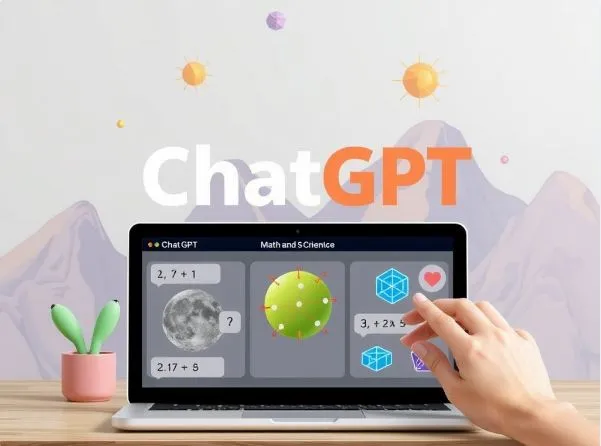
ChatGPT can now build interactive visual diagrams right inside the chat window. Not screenshots. Not static images you stare at helplessly. Actual, living diagrams where you can drag values, change numbers, and watch the whole thing update in front of you in real time.
Think of it this way: instead of reading “when you increase resistance, the current decreases,” you get a circuit diagram. You slide the resistance up yourself. You watch the current drop. That’s a completely different experience — and honestly, it’s the kind of thing that makes a concept stick.
How Does It Actually Work?
Here’s the part that makes this practical, not just impressive on paper.
When you type something like “show me how Ohm’s law works” or “explain the Pythagorean theorem,” ChatGPT recognizes what you’re asking about and builds a visual module paired with the relevant formula. No plugins. No extra setup. It just appears in the chat.
From there, you become the experimenter. Want to know what happens to the hypotenuse if you change the length of one side of a triangle? Change it. Want to see how increasing voltage affects current flow? Adjust the slider. The diagram responds immediately, and suddenly you’re not reading about a concept — you’re playing with it.
The technology underneath is a combination of OpenAI’s language models and live computation rendering. The important thing for everyday users is that none of that matters to operate. It’s as simple as asking a question.
Who Is This For?
The honest answer: almost anyone who’s ever struggled to connect a formula to what it actually means.
Right now, the feature covers more than 70 topics — things like kinetic energy, compound interest, Coulomb’s law, lens equations, and geometric principles. It’s calibrated for high school and college-level learning, which puts it squarely in the sweet spot for students grinding through coursework, self-learners trying to fill knowledge gaps, and teachers looking for a smarter way to demo concepts in class.
OpenAI says around 140 million people use ChatGPT every week for math and science questions. That’s a staggering number, and it tells you something important: people are already turning to AI for this stuff. The question was always whether the AI could do more than just explain things in words. Now it can show you — and let you touch it.
Here’s the thing educators have known for years: memorization is fragile. You can cram a formula the night before an exam and forget it a week later. But if you’ve experimented with something — if you’ve changed the variables yourself and watched what happens — it lands differently. The understanding is sturdier.
That’s what makes this update feel significant rather than just flashy. It shifts the dynamic from “let me tell you how this works” to “let’s figure it out together.” That shift from passive reading to active exploration is exactly how understanding gets built and retained.
For teachers specifically, this opens up a genuinely useful tool for demonstrations. Instead of drawing a diagram on a whiteboard and hoping it communicates, you can pull up a live, adjustable version that students can interact with.
How Do You Get Started?
The best part: there’s nothing to activate. If you have a ChatGPT account — on any plan — the feature is already there. Just open a chat and ask about a supported topic.
Try something like:
- “Can you show me how the Pythagorean theorem works visually?”
- “Demonstrate Ohm’s law with an interactive diagram.”
- “Show me how compound interest grows over time.”
The visual will appear, and from there, start changing things. That’s really it. If you ask about something outside the supported 70+ topics, you’ll get a text explanation instead — but for the subjects it covers, the experience is noticeably different from anything ChatGPT has offered before.
This isn’t a gimmick. Interactive, manipulable visuals tackle one of the oldest problems in education: the gap between knowing a formula and understanding what it actually means in the real world. For students, it’s a homework companion that goes well beyond definitions. For teachers, it’s a demo tool that makes abstract concepts tangible. For anyone curious about how things work, it’s just genuinely fun to use.
The feature is live, free to access on all plans, and available worldwide right now. If math or science is any part of your life — or someone you care about’s life — it’s worth five minutes to try.