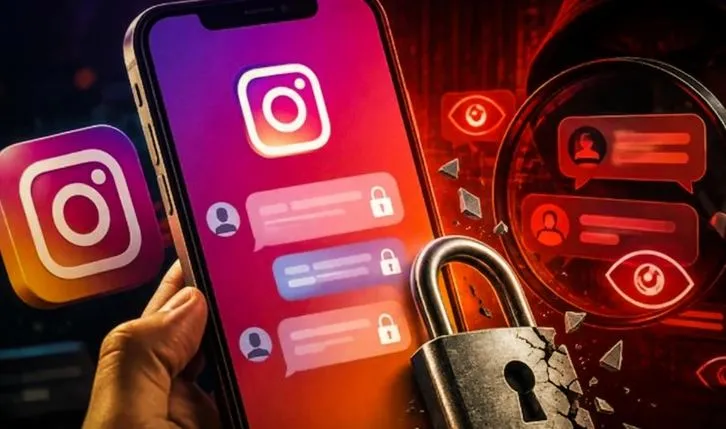
As of today, May 8, 2026, Instagram has permanently removed end-to-end encryption (E2EE) from all direct messages. If you use Instagram to share anything personal, professional, or sensitive, this change affects you directly. Here is everything that matters, ranked from most urgent to least.
- Act Today — Your Window Is Closing
Before anything else, download your encrypted chat history. Once Meta’s servers fully convert your messages to standard format, that data becomes readable by the platform — and potentially others. Go to Settings → Your Activity → Download Your Information, select Messages and Media, and request your archive. This process can take anywhere from 24 to 72 hours, so start immediately. Some users may get a short grace period through May 11, but this is unconfirmed. Do not wait.
- Your DMs Are No Longer Private
From this point forward, every message you send or receive on Instagram — including text, media, and attachments — is stored in readable form on Meta’s servers. Unlike WhatsApp, which has offered encryption by default since 2016, Instagram’s E2EE was always optional and required manual activation for each individual conversation. Fewer than 1% of users ever turned it on. Meta used this low adoption as justification to shut the feature down entirely.
What this means practically: Instagram can now scan your messages for content moderation, advertising signals, and compliance with government requests. Features like vanish mode and locked chats still exist, but they no longer carry any encryption protection.
- Why Meta Really Made This Move
Meta publicly blames low usage, but the business logic runs deeper. Access to DM content opens up significantly richer advertising data — analysts estimate a 15–25% boost in targeting precision, potentially worth over $50 billion annually. Additionally, Instagram’s message data may feed into Meta’s Llama AI training pipeline, with opt-out options buried deep in policy settings. On top of that, maintaining a separate encryption system alongside WhatsApp was costing the company an estimated $200 million or more per year. Dropping E2EE on Instagram consolidates everything onto a single technical stack.
- Who Benefits — And Who Doesn’t
Governments and law enforcement agencies globally have welcomed the change. Removing encryption makes it significantly easier to scan for child sexual abuse material (CSAM), detect grooming behaviour, and flag terrorism-related content. This aligns with legislation including the US EARN IT Act, EU Digital Services Act, India’s IT Rules 2021, and Australia’s eSafety requirements.
Privacy advocates see it very differently. Organizations like the EFF and Proton have called this move a step toward mass surveillance normalization, warning that DM access opens the door to government data requests, third-party sharing, and targeted advertising based on private conversations. For users in India, there are additional concerns: the change appears to conflict with the Digital Personal Data Protection (DPDP) Act’s requirements around consent and data minimization, and could expose users to surveillance through certified intermediary channels.
- Where to Go If You Need Real Privacy
If you want genuinely private messaging going forward, you have better options:
Signal remains the gold standard — true end-to-end encryption, disappearing messages, no data harvesting. WhatsApp offers E2EE by default, though it still sits within Meta’s ecosystem. Telegram is widely used but stores messages on its servers by default unless you use its “Secret Chat” feature specifically.
If you are a creator or influencer in India, legal experts suggest documenting any privacy concerns through formal channels and monitoring how TRAI responds to DPDP-related complaints about this change.
- The Bigger Picture
Instagram’s decision reflects a wider global trend where platforms are being pressured — legally and commercially — to prioritize content scanning over user privacy. Meta has effectively split its messaging strategy: WhatsApp handles secure communication, while Instagram serves as a content and commerce platform where full message visibility suits both its business model and regulatory obligations.
For everyday users, the takeaway is straightforward. Instagram DMs were never the most private channel. Now they offer no privacy protection at all. Treat them accordingly — and move sensitive conversations elsewhere.