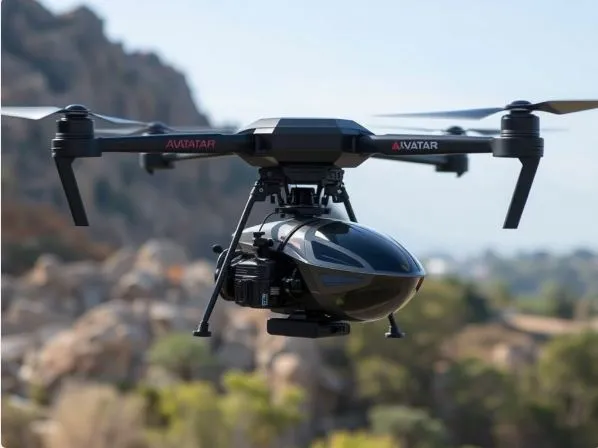
Imagine you’re a naval officer tasked with securing a stretch of coastline. You need eyes in the sky to track suspicious vessels, but you also need something that can slip beneath the surface and check whether a diver has attached something dangerous to a ship’s hull. Traditionally, that means two separate teams, two separate vehicles, and a whole lot of coordination. Now imagine one drone that does both — and does it alone.
That’s exactly what a Bengaluru startup called AquaAirX has built. Their drone, named Avataar, is India’s first amphibious drone — a machine that flies through the air like a regular quadcopter and then, without any help from a human handler, dives underwater to continue its mission. It was unveiled in early March 2026, and it’s already turning heads in defense and maritime circles.
Built for Two Worlds
The first thing worth understanding about Avataar is that making something work in both air and water is genuinely hard. Air and water are completely different environments — water is about 800 times denser than air, saltwater corrodes metal rapidly, and navigating underwater is nothing like flying in open sky where GPS works perfectly.
AquaAirX solved this by building Avataar with a shark-inspired carbon fiber body treated with coatings that resist saltwater corrosion. The propellers are designed to switch roles — they lift the drone in the air and then power it underwater. The whole system is sealed and ruggedized. After each mission, operators rinse it with freshwater to keep the sensors and structure in good shape. Think of it like how you’d rinse a wetsuit after a dive in the ocean.
How It Actually Works
Here’s how a typical mission might go. You launch Avataar from a coastal station or a ship. It flies out to the target area using GPS and onboard cameras — just like any other drone you’ve seen. When it reaches the water, it lands on the surface and begins its dive. A smart safety system prevents it from submerging if the battery is too low, because getting stuck underwater would be a very bad day.
Once it’s beneath the surface, things get interesting. There’s no GPS underwater, so Avataar switches to echolocation — the same basic principle dolphins and bats use. It sends out sound pulses, listens for the echoes bouncing back off objects, and uses that information to build a 3D map of its surroundings in real time. In murky port water where visibility might be near zero, this is genuinely game-changing.
To stay on course despite strong ocean currents, it uses something called a Doppler Velocity Log — basically a sophisticated underwater speedometer that measures movement relative to the seafloor, keeping the drone precisely positioned even when the water is pushing hard against it. And to send data back to operators while submerged, it uses acoustic signals — converting information into sound waves that travel through the water, functioning as a kind of underwater Wi-Fi.
LED lights help with visibility during inspections, and the drone can carry up to 4 kg of sensors — cameras, sonar arrays, whatever the mission demands.
Why This Actually Matters
Let’s be real about what problem this solves. Right now, if the Indian Navy wants to monitor a harbor for underwater threats, they need divers or an underwater remotely operated vehicle (ROV). If they want aerial surveillance, they need a separate drone. These are expensive, slow to deploy, and require support crews.
Avataar rolls both into one package. It can patrol a coastline from the air, spot something suspicious, dive to investigate, and relay findings back — all autonomously, following pre-set waypoints without someone holding a controller the entire time. The military term for this kind of capability is ISR: Intelligence, Surveillance, and Reconnaissance. Avataar handles all three across two completely different environments.
Beyond defense, the applications are wide. Offshore oil rigs need their underwater pipelines and cables inspected regularly for cracks or leaks — dangerous work that usually involves human divers or slow ROVs. Avataar can fly out quickly, dive, inspect, and return. In search-and-rescue scenarios at sea, minutes matter. A drone that can cover large areas from the air and then dive to confirm a sighting is enormously valuable.
Where Things Stand
Avataar has crossed what engineers call Technology Readiness Level 6 (TRL-6), which means it has been validated in a relevant environment — not just a lab. AquaAirX claims over 10,000 flight hours of validation, which is a meaningful number for a system this new and complex.
AquaAirX was incubated at NMIT and NSRCEL, two respected Indian innovation ecosystems, and is clearly aimed at institutional customers — the Navy, the Coast Guard, oil and gas operators — rather than consumers. If you want to get your hands on one, you’d be reaching out to them directly for a demonstration.
India has been rapidly expanding its homegrown defense technology, and Avataar is a strong signal of where that’s heading. It’s not a concept or a prototype render — it’s a working system that tackles a genuinely difficult engineering problem and solves a real operational need. For anyone involved in maritime security, underwater infrastructure, or coastal surveillance, this drone represents exactly the kind of multi-role, cost-reducing capability that makes procurement officers pay attention. One vehicle. Two domains. Zero external support needed. That’s a compelling pitch.